
Container ship and yard maintenance coating
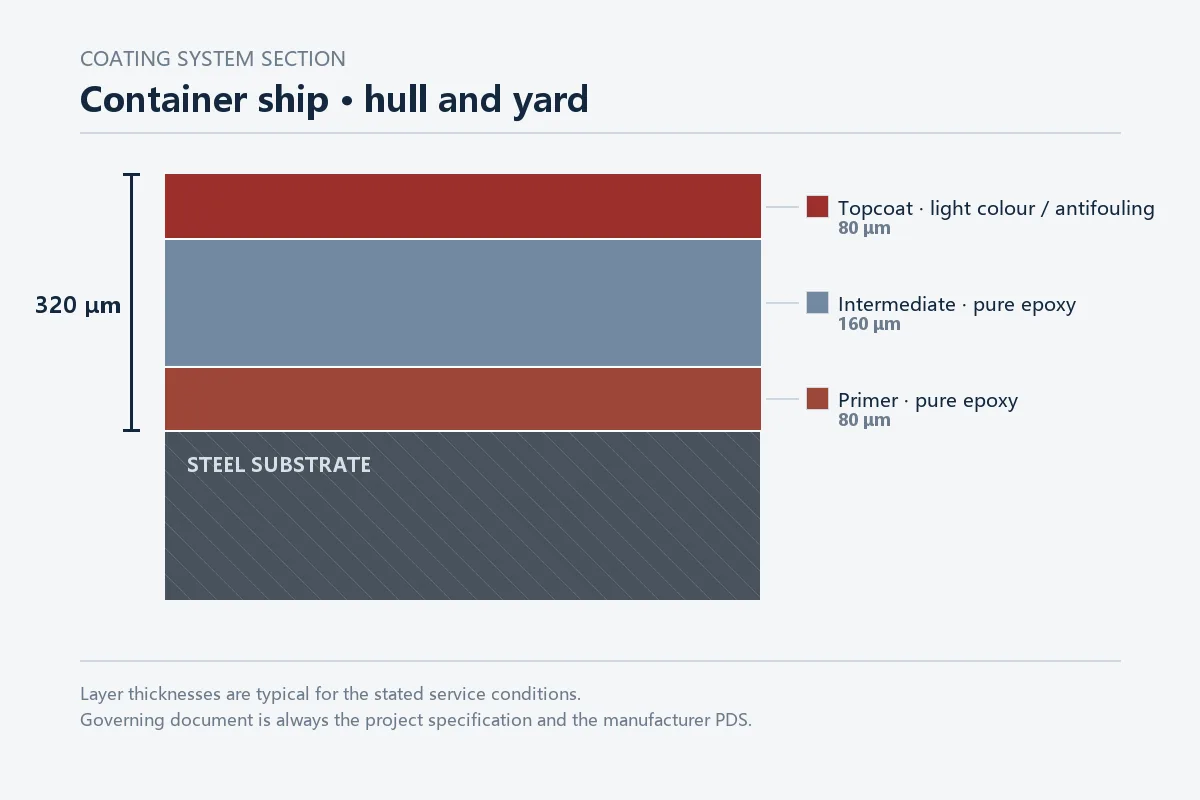
Coating system
| Layer | Material / system | DFT | Standard | |
|---|---|---|---|---|
| Primer | Pure epoxy primer (ballast-tank approved) | 80 μm | IMO PSPC / Res.215(82) | |
| Intermediate | Pure epoxy intermediate, light colour for inspection | 160 μm | IMO PSPC / Res.215(82) | |
| Topcoat | Ballast: light-coloured topcoat of same system; hull: self-polishing antifouling | 80 μm | IMO PSPC / AFS 2001 | |
| Total system DFT | 320 μm (ballast tanks) | |||
Ballast tanks to PSPC; below-waterline hull gets self-polishing antifouling, above waterline polyurethane topcoat.
Container ships and yards are immersed in seawater, wet-dry cycling and heavy salt spray; hull antifouling and deck wear resistance are critical. Scope covered hull above/below waterline and yard steelwork maintenance.
Below the waterline a self-polishing antifouling system was used; above it, epoxy primer with polyurethane topcoat. Decks and yard steelwork used wear-resistant epoxy finishes; ballast tanks followed PSPC requirements.
Work was divided between dry dock and quay, controlling surface salt and humidity; antifouling application windows followed the sailing schedule. Acceptance covered DFT, adhesion, antifouling film thickness and appearance.
The build-ups above are typical systems compiled from ISO 12944 and the relevant product technical data sheets; film thicknesses are reference values for the service conditions stated. For any specific project, the design specification, tender documents and the manufacturer's latest PDS govern. Actual performance depends on surface preparation grade, ambient conditions during application and recoat intervals.